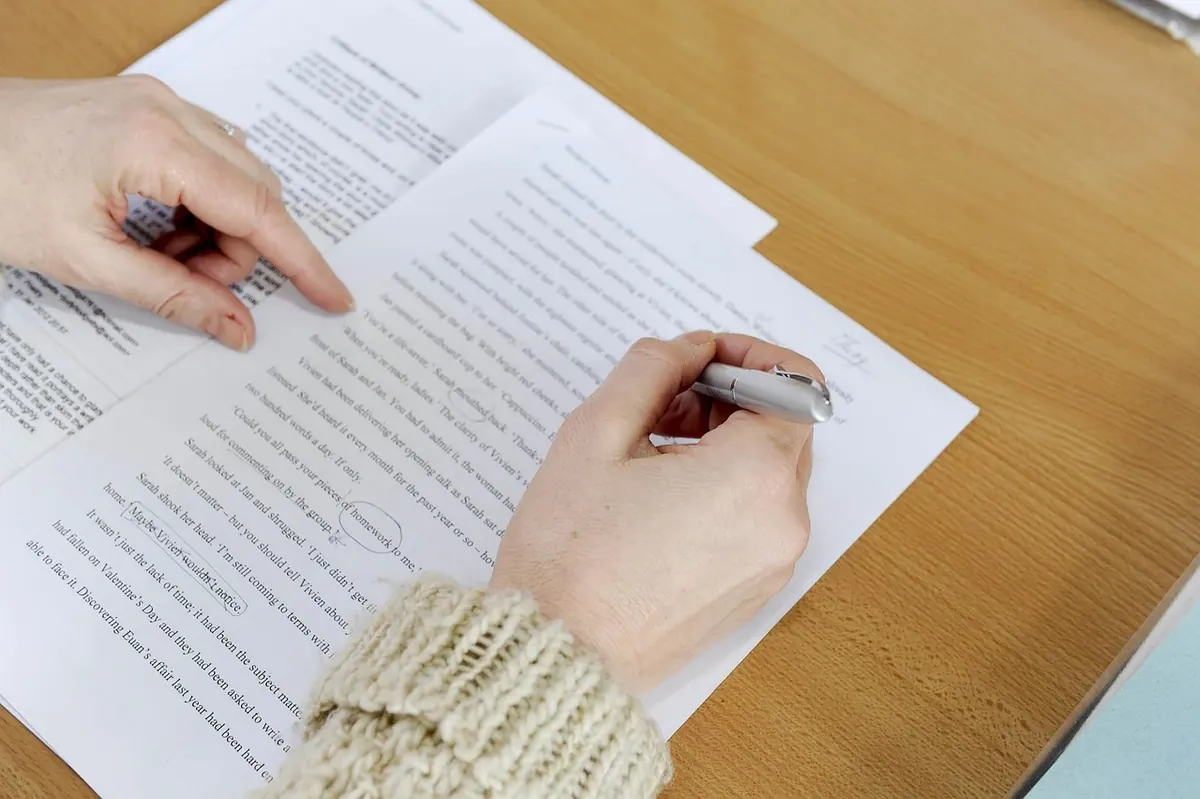
You can usually spot a self-edited manuscript within a page or two. Not because it's bad — most of what reaches an editor isn't — but because the same three problems turn up in the same order. A scene explains itself instead of dramatising anything. The narrator keeps announcing what characters feel. And somewhere in chapter four, a verb slips out of the past tense and never quite comes back.
None of that means the writer is weak. It means they were reading for meaning rather than mechanics, which is what happens when you're deep in your own story. All three are fixable, and fixing them yourself means the editor you eventually hire spends their time on what only an outside eye can catch.
The "Show, Don't Tell" Rule Is Really a Ratio
"Show, don't tell" is the most repeated advice in fiction and the most misunderstood. Taken literally, it's impossible: a novel that showed everything would run to nine thousand pages, and you'd still have to tell the reader it was Tuesday.
Every manuscript tells. Good manuscripts tell on purpose. The ratio is what matters, and so is the placement. Telling is summary — it compresses time, moves characters between rooms, and handles the beats nobody needs to watch. Showing is scene — it slows down, hands the reader evidence, and lets them reach a conclusion before the narrator says the word "sad."
What Accidental Telling Looks Like
Accidental telling almost always appears at the exact moment the reader wants to slow down. Someone gets bad news, and instead of a cup coming down too hard on a table, we get this:
Marcus was devastated. He couldn't believe what she'd said. He felt angry and hurt and confused all at once.
Three sentences, all of them announcement. The reader is handed the result of an emotion without any of its evidence. Compare:
Marcus set the cup down. It clicked against the saucer, then rattled, because his hand wasn't steady. "Say that again," he said.
Same beat. Same information. But now the reader is doing the work, and doing the work is what makes a scene feel like it is happening rather than being reported. Notice the second version never names an emotion at all, which is usually the giveaway that it's working.
When Telling Is the Right Call
Telling earns its keep in a handful of places, and you should use it without guilt:
- Time compression. "Three weeks passed before the letter arrived" beats a scene of three weeks passing.
- Transitions. Moving a character across a city, or a paragraph, without writing a travelogue.
- Repeated action. If a routine happens fifty times, dramatise it once, then summarise the rest.
- Minor characters and background. Not every stranger needs a scene.
- Deliberate distance. Sometimes a narrator's flatness is a character choice, not an error.
The test isn't show or tell. It's does this moment carry weight? If it does, dramatise it. If it doesn't, summarise it and move on.
Tense Shifts and the Drifting Narrator
Tense drift is the mistake that survives the most revision, because it nearly always sounds fine in isolation. You read a sentence, it scans, you keep going. Ten pages later the past tense has quietly become present and nobody has noticed, least of all you.
The Three Varieties
- The straight slip. A single verb lands in the wrong tense — usually in a subordinate clause, or right after a paragraph break when the writer's ear has reset. "She walked to the door and the handle is cold."
- The habitual past problem. Habitual action in a past-tense narrative wants "would" or "used to." Without it, a repeated action reads like a present-tense event. "Every summer we drove north" is fine; "Every summer we drive north" is a shift half your readers will feel and none will be able to name.
- The flashback collapse. Flashbacks open in pluperfect — she had left, he had waited — and then the writer, sensibly, drops the "had" to avoid a page of clanking grammar. That's correct. But the exit back to the present timeline needs a clear marker, or the reader spends two pages unsure what year it is.
How to Catch It
Don't hunt for tense while you're editing for anything else. You will miss it every time. Give it a dedicated pass and use these:
- Search for "is," "are," "was," "were," "has," "have." Not to delete them — just to look at them. Half of all drift lives in those six words.
- Read aloud, or let a text-to-speech voice read to you. Your eye auto-corrects tense on the page. Your ear does not.
- Check every paragraph break and scene break. That is where the reset happens.
- Check dialogue tags and interior thought. Reported speech and free indirect thought are where tenses get mixed most often.
POV Drift: The Problem Nobody Warns You About
If show/tell and tense are the first two things an editor marks, POV drift is usually the third. It's subtler and it does more damage, because it isn't a matter of grammar. It's a matter of whose head we're in.
In a close third-person or first-person narrative, the reader is only allowed to know what the viewpoint character knows. The moment the prose reports something that character couldn't perceive, the spell breaks — even if the sentence is beautiful. A character who cannot know their lover's thoughts suddenly reports them. A character facing a locked door suddenly describes the hinges from the far side of the room.
Watch for these tells:
- Emotions or intentions assigned to a non-POV character without an outward sign to justify them.
- Descriptions of the viewpoint character's own face, which nobody sees without a mirror.
- Information the POV character hasn't learned yet, delivered as narration.
- Group thoughts: "Everyone in the room knew it was over."
Fixing POV drift is often just a matter of re-attribution — moving the knowledge from the narrator to a character's inference. "She was disappointed" becomes "Her mouth did the thing it did when she was disappointed." Small change, entirely different relationship between reader and page.
A Self-Editing Pass Order That Actually Works
The reason most self-editing stalls is that writers try to fix everything at once and end up fixing nothing. Structure the passes. Read for one thing per pass, in this order:
- Structure and scene purpose. Does every scene change something?
- Show/tell ratio. Find the three most important emotional beats in each chapter. Are they dramatised?
- POV consistency. One head per scene, and no knowledge that head can't have.
- Tense. A dedicated pass. Nothing else in it.
- Sentence-level rhythm. Repetition, filter words, overused constructions.
- Line proof. Typos, punctuation, consistency of names and details.
Do them in that order, because each pass invalidates work done in the ones below it. Changing a scene's structure after you have polished its sentences means polishing them twice.
What This Buys You
Every error you catch yourself is one your editor doesn't have to charge you for, and — more importantly — one your editor doesn't have to spend attention on instead of the deeper problems. A manuscript that arrives with clean tense, a deliberate show/tell balance, and a consistent POV tells a professional something useful before they've read a word of the story: that the writer knows the difference between drafting and editing.
That's the whole game. You don't need to be a better writer to fix these. You need to read like someone who isn't the author, one pass at a time.
Photo: WokinghamLibraries / Pixabay